
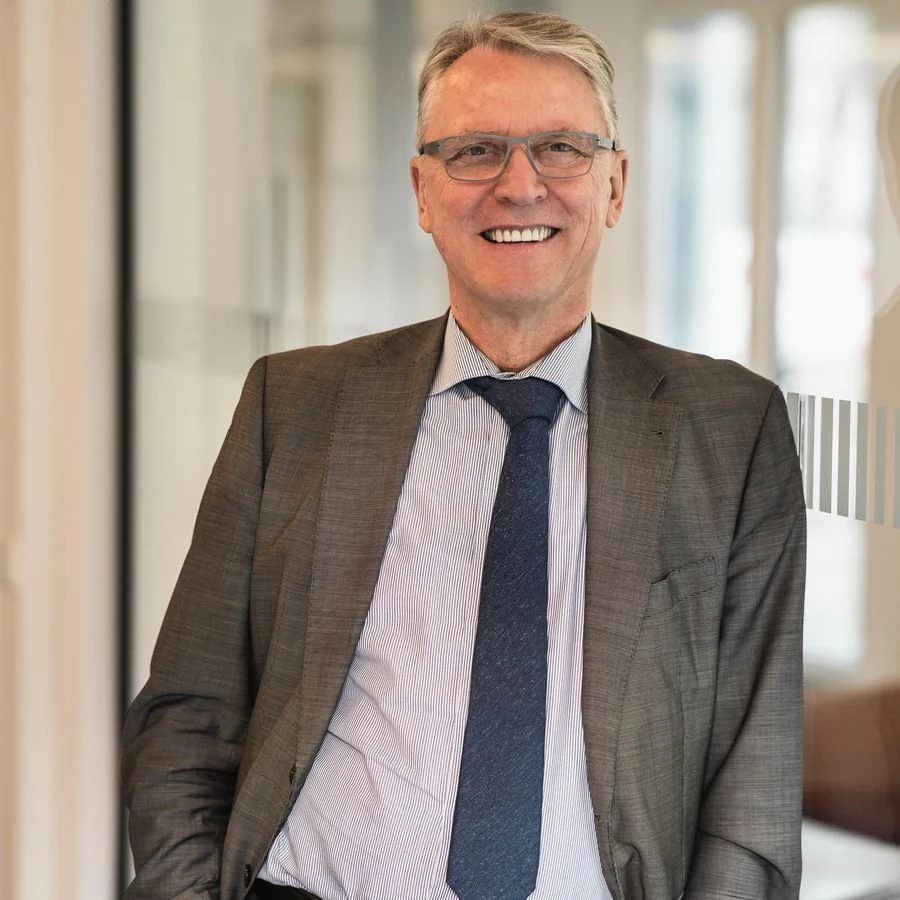
An editorial profile about academic institution-building, digital education infrastructure and the relevance of new university models to Europe’s technological agency.
Personal support for an overarching mission
Prof. Dr. Christoph Meinel personally supports the overarching VENTEX mission: connecting digital sovereignty, resilient infrastructure, secure communication and responsible digital education in Europe. This page records that support and the professional record behind it.
Both sides start from the same question: how does Europe stay technologically capable when communication, infrastructure and education have to be thought through together? Prof. Meinel’s decades of work on digital education and internet technologies and the VENTEX standard for secure operational communication meet at exactly that point.
Nearly two decades of institution-building at HPI
From 2004 to 2023, Christoph Meinel led the Hasso Plattner Institute for Digital Engineering as Managing and Scientific Director. Internet technologies, information security, digital learning platforms and new models of digital engineering were among the defining fields of his work during this period.
His record connects technical research with institution-building. It includes the development of openHPI, a European platform for open online courses serving an international learning community. That combination of technology, access and scalable teaching continues through his present work.
- Director and Managing Director of HPI from 2004 to 2023
- Founding Dean of the Digital Engineering Faculty from 2017 to 2021
- Research and teaching in internet technologies and information security
- Development of digital education platforms including openHPI
German UDS: a university conceived as digital
Christoph Meinel is one of the two founders of the German University of Digital Science and now serves as its President and Head of the Research Group Digital Education and Internet Technology. Following state recognition, the university began academic operations on 1 April 2025.
German UDS does not simply translate established on-campus teaching into video calls. Study organisation, teaching formats, collaboration and access are designed as a digital-first model. All programmes are offered in English and can be completed fully online, with an explicitly international orientation.
AI, cybersecurity and digital leadership as fields of study
At launch, the portfolio comprised one-year MBA programmes in Digital Transformation and Digital Technologies and two-year master’s programmes in Applied Artificial Intelligence, Cybersecurity, Advanced Digital Reality and Digital Leadership. Shorter micro-degree programmes complement the degree portfolio for professional learning.
In its first-anniversary review in April 2026, German UDS reported more than 100 students from over 20 countries, 17 professors and a portfolio of four master’s and two MBA programmes. These figures are a dated institutional snapshot; the university continues to develop its academic offering.
That development continues. In July 2026, German UDS and the Berlin College of Business and Technology announced a Founder’s MBA pathway connecting digital transformation with an internationally oriented entrepreneurship degree. The expansion illustrates how the university is extending its fully digital core model through new academic pathways.
- Fully digital, English-language degree programmes
- Applied AI, Cybersecurity and Advanced Digital Reality
- Digital Leadership and Digital Transformation
- International access and formats compatible with professional life
Why digital university models matter to Europe
Europe’s technological future depends on more than data centres, regulation or individual products. It also depends on whether people can understand digital systems, shape them responsibly and collaborate across organisational and national boundaries.
A fully digital university model can connect reach, international collaboration and lifelong learning in new ways. German UDS therefore represents a concrete institutional experiment within Europe’s education landscape. Prof. Meinel’s work shows that digital infrastructure and education do not need to be treated as separate questions — a perspective that also touches the long-term VENTEX mission.
Recognition of a scientific record
VENTEX recognises Prof. Meinel as a scientist and institution-builder who has connected technical research, digital education and organisational development over several decades. His personal support for the VENTEX mission is a strong signal for us.
It reinforces a standard we set for ourselves anyway: the development of VENTEX Connect stays tied to technical evidence, documented boundaries and independent scrutiny. That attitude is precisely what connects us to people who have brought science and practice together over decades.